

Angels & Demons
The Forgotten War Beneath the Stage

A Field Report on Two Ancient Species the Fae Did Not Replace — Only Survive
Compiled for the Concordant Archives, Endless City High Library.
Circulation: Restricted to Imperial Scholars, Shadow Order Historians, and Entities of Proven Stability.
I. The Pre-Fae Universe: A Realm Already at War
When the Fae first crossed the veil into this universe—eons before the Treaty, before the Houses, before the Endless City was raised—the realms they discovered were not empty, nor quiet, nor welcoming.
They were occupied.
Two species already dominated this cosmos:
The Angels
The Demons
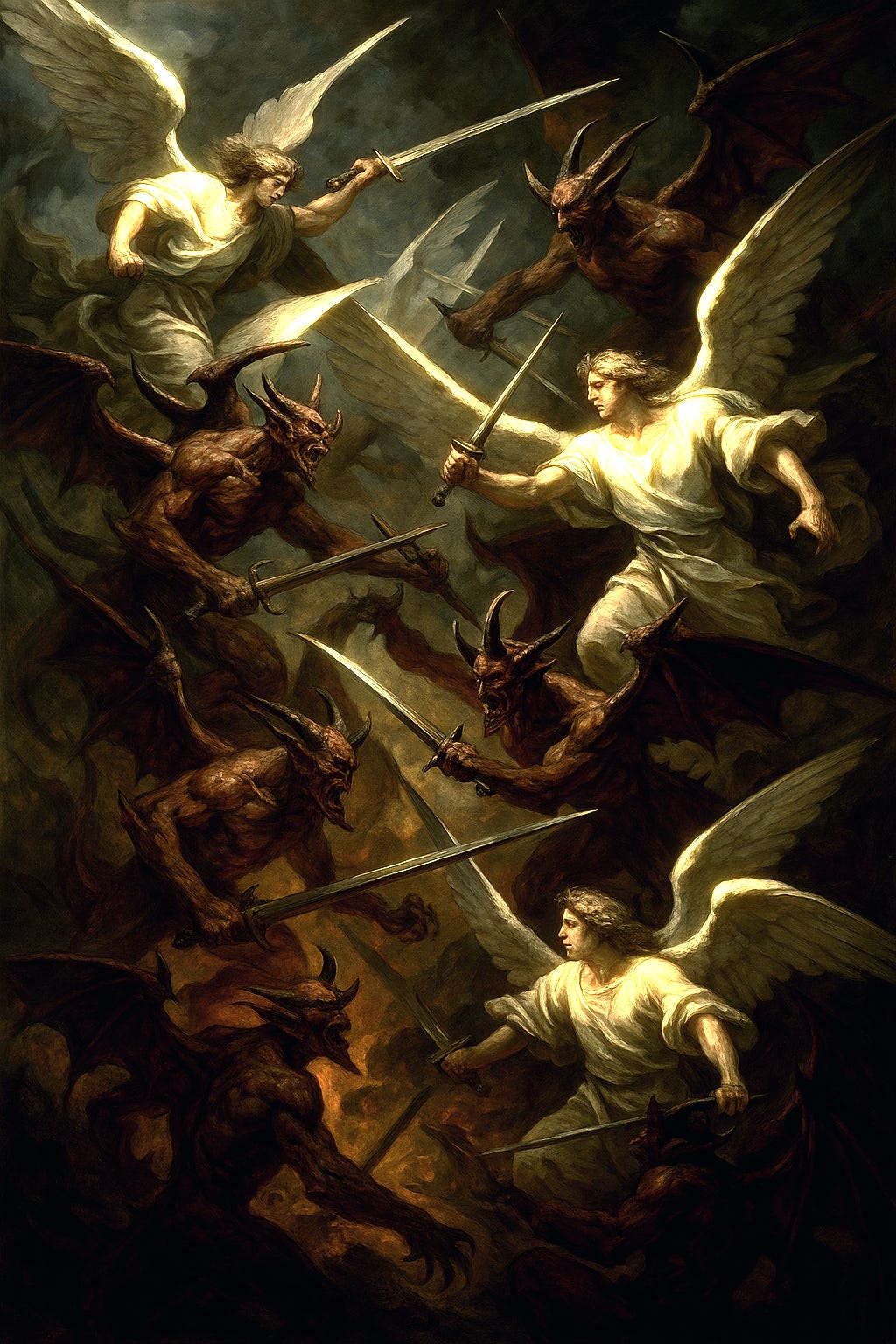
They were not metaphors or moral constructs.
They were not divine servants.
They were simply native lifeforms of this reality, born from the first bifurcation of existence.
Their roles were rigid because the universe itself was rigid in those days.
Angels embodied the Principle of Order
A stabilising force.
Self-repairing logic.
The early universe’s desperate attempt to hold itself together.
Demons embodied the Principle of Self-Interest
Not evil.
Not infernal.
Simply autonomy refined until it burned.
They were the rebellion inherent to all emergent systems—entropy with intention.
Their conflict was inevitable.
Their war was ancient long before the first Fae three pierced the boundary between universes.
And neither side had the imagination to stop.
II. The Arrival of the Fae: The Third Variable
When the Fae arrived from their universe—drifting through the magical ruptures they’d forced in the aftermath of their own catastrophes—they did not enter a quiet cosmos.
They entered a binary madhouse.
To the early Fae refugees, Angelic and Demonic forces appeared:
astonishingly loud in purpose,
distressingly simple,
and trapped in an argument so old it had calcified into instinct.
The Fae called them:
“The Twinned Stagnancies.”
Because in their eyes, neither faction truly lived.
They repeated.
The early Fae assessed them with the detached curiosity of a species accustomed to infinite nuance:
Angels:
“Creatures who cannot imagine a world not ruled by their rules.”
Demons:
“Creatures who cannot imagine a self not ruled by their wants.”
And most damning:
“Both sides are exhausted, and neither knows how to stop.”
The Fae avoided their war not out of fear—
but out of boredom.
III. How Angels and Demons Viewed the Fae
The first recorded Angelic assessment of the Fae reads:
“Non-compliant variables.
Dangerous.
Illogical.
Disturbingly adaptive.”
The first Demonic report describes the Fae as:
“Unpredictable.
Annoying.
Too clever to kill.
Too chaotic to trust.”
Neither faction understood that the Fae were not of this universe.
Not built from its principles.
Not beholden to the old duality.
They were an imported species of contradiction:
emotion-driven, ritual-bound, creativity-forward, aesthetically charged, strategically irrational.
They broke the binary war simply by existing.
IV. The War in the Dreaming: The Humbling of All Species
The Nothing did what no Angel and no Demon had managed to do in millions of years:
It made them equal.
When the Fae, Angels, Demons, Lost, mortals, and Umbra-born stood on the same battlefield, something unprecedented occurred:
They all died the same way.
No divine immunity.
No infernal resistance.
No predetermined survival.
Angels screamed and burned.
Demons dissolved and vanished.
Fae broke, reformed, or went mad.
Everyone bled.
The Nothing recognised no hierarchies.
And in that shared mortality, the Fae gained their first true respect for these ancient beings:
“They die like us.
Therefore they live like us.”
Some Angels fought under the Treaty banner.
Some Demons tore into the Nothing out of fury.
Many simply stood still, confusde, exhausted beyond purpose, waiting for annihilation.
The Fae remember this.
It changed everything.
V. After the Treaty: The Collapse of the Old Orders
The Treaty did not just bind the Fae.
It broke the Angels and Demons.
The Emperor’s arrival—a presence perceived differently by every witness—snapped the old axioms in half. Order and Self-Interest, the very principles that birthed these species, no longer defined reality.
Their hierarchies collapsed overnight.
No more Choirs.
No more Legions.
Only individuals.
Creatures built for singular purpose suddenly found themselves unmoored.
They wandered.
They faltered.
They adapted poorly.
But some did adapt.
VI. The Endless City: The Great Neutral Zone
The Endless City quickly became the only realm where:
Angels
Demons
Fae
Umbra-born
mortals
and entities with no stable classification
could coexist without mandatory conflict.
Not by choice.
But by the City’s nature.
The City tolerates everyone.
The City consumes everyone.
And everyone eventually accepts this.
The Demon Prince, once a general of rebellion, now runs The Cartel—the City’s largest criminal organisation.
That a primordial being of cosmic autonomy now manages protection-rackets and vice halls is a joke the universe has never explained.
Some Angels wander the City’s upper districts out of habit or resignation.
Some serve as mercenaries.
Some drink.
Some wait for something that will never return.
Ancient enemies often sit at neighbouring tables.
The Fae consider this the funniest thing that has ever happened to either species.
VII. Earth: The Theatre They Lost
Earth was the traditional Angel–Demon battleground.
A realm where both species left deep psychic traces.
Human religions preserved these memories with surprising accuracy.
The Rats erased all that without a war.
Their 2025 AOC takeover of Earth—silent, precise, inevitable—was a humiliation neither Angels nor Demons will recover from.
Humans did not resist.
Humans did not rebel.
Humans simply slid into new order as if rehearsed.
Angels call it corruption.
Demons call it theft.
Both know the truth:
Earth chose the Rats.
Not through magic.
Through resonance.
The Fae rarely comment on this aloud.
Their silence is the sharpest insult.
VIII. The Fae Perspective Then and Now
When they first arrived:
“These creatures are old.”
“These creatures are simple.”
“These creatures are trapped.”
“Their war is predictable.”
“They cannot adapt.”
Now:
“They survived because we did.”
“They owe the Emperor their continued existence.”
“They are dangerous only in the way old knives are dangerous.”
“They are relics with free will.”
“Some are worth respecting. Others are not.”
“Their war is over, even if they don’t know it.”
Across Houses and Courts, one unified sentiment has emerged:
Angels and Demons are no longer cosmic players.
They are individuals—nothing more, nothing less.
The universe moved on.
They did not.
IX. Echo’s Commentary (Sealed Record)
A single note preserved from Lord Echo, transcribed reluctantly:
“They argue because they cannot change.
They fight because they cannot imagine not fighting.
Their first purpose became a prison.
Their prison became their nature.
Their nature became their tragedy.”
And on the Demon Prince:
“The only one who adapted.
Evolution through vice.
Impressive.”
And on the Angels:
“A mirror I declined to inhabit.”
Echo’s view is considered canonical by Imperial scholars,
if only because he is rarely wrong.
X. What They Are Now
Angels and Demons have become:
wanderers,
relics,
survivors of an irrelevant war,
beings in search of purpose,
veterans without armies,
guardians without thrones,
rebels without a king to defy.
They mingle in the Endless City.
They bleed in the same alleys as Fae.
They drink in the same bars.
They take the same contracts.
They fall into new patterns because the old ones have died.
Their war continues only as reflex.
As instinct.
As the last echo of a universe that no longer exists.
But they remain.
And in the Endless Chronicles, beings who remain always find a place in the next chapter—
even if the place is not the one they expected.